Earth Fest 2010!


Seamus, Emily, chickens, and I had a great day at Earth Fest!

Showing the buff Orpington to a little guy!

Exciting Conversations

I spoke to a number of folks who are interested in getting chickens, exhausted my stack of rate sheets, and allowed a lot of really cute kids to pet a chicken for the first time!

It’s very exciting to see this many people excited about chickens (and I realize as I look at the pictures how excited I am about chickens!)!

I'm not having any fun at all!

I answered question about housing, square footage per bird, chickens and other pets, anatomy, eggs, composting, emergency care, breeds and cold hardiness, coop design, etc.

My favorite question is

Q: Do you eat chicken?

A: Only chickens I don’t know!

My Lovely Assistant

Emily was a wonderful PR rep, despite having just come from ballet, graciously fielding questions about her chickens and carting them from one end of the table to the other!

Emily with Joe Schmoe, the buff Orpington hen

RootRiot Community Garden

Seamus spoke with quite a number of folks about his RootRiot Community Gardens in Austin. The proposed site is between Race and Lake on Waller. Some Austin folks will be meeting in late April/early May to discuss the project. If you’re interested in knowing more, you can find Seamus at www.lowcarbonhome.com and www.environmentalcitizen.net.

Seamus discusses his community garden plans.

Thanks to everyone who stopped by and asked lots of good questions!

Q: Are chickens permitted in Forest Park?

A: No, per the Forest Park Village code: 5-1-2: PROHIBITED ANIMALS: No person shall keep or allow to be kept anywhere within the village any cattle, horses, swine, sheep, goats, ducks, geese, chickens or any other poultry except birds or pigeons used for exhibition or sporting purposes. (Ord. O-48-01, 11-19-2001) http://sterling.webiness.com/codebook/index.php?book_id=422

Q: Is there an egg co-op in the city? Someone is interested in purchasing egg-cess eggs.

A: The Wettsteins bring fresh eggs to the Oak Park Farmers Market. They are right across from the Genesis Growers stand.

One more for my loyal readers:

  • Does anyone in the city have ducks? A few people are interested in ducks!

Chicken Poop Wanted!


Have unwanted chicken poop? Call Andi: 708-945-0532.

She is looking for chicken droppings for composting – Oak Park, River Forest, Forest Park. She will come to collect from you.

Update on hen with soft-shelled egg


Great news! Maisie the hen is doing well! Her owner had this to say:

“Thanks again for your help w/ Maisy. She’s doing much better now that she’s got calcium in her. She’s back in with the other hens (has been for a week+ now), and we’re getting 3-4 eggs daily out of the four of them (we waited patiently until she finally gave us one in her private cage before getting her back in w/ the others).”

What great news!

The scoop on poop, or how is poop like raku pottery?


A raku pottery box that I made in pottery class

So chicken poop can be amazingly stinky! Why is that? Well, the basic chemistry is that there is a lot of ammonium in there. As you’ll recall (or not) from high school chem class, ammonium is NH4 –four hydrogen atoms around a nitrogen atom. Through chemical processes not to be expounded upon here, but which you can read at your leisure (there will be a test later) here, that smelly poop is a great source of nitrogen for your garden and compost heap.

There is also the idea that chicken poop might be used as a biofuel through a technology called pyrolysis (from the Greek pyro “fire” and lysis “decomposition”). The resulting product is called biochar, and it consists of chicken droppings that have been cooked in an anaerobic environment (that is, without oxygen – sort of like the reduction environment needed to make really nice raku pottery – but the end results are not nearly as aesthetic). Cooking the poop in an anaerobic environment prevents release of carbon! et voila! We have a fixed-carbon fertilizer!

Now before you go out and raku fire your chicken poop, you might find this article to be informative about the biochar process.

And, there, I’ve just incorporated 4 of my favorite topics (chickens, chemistry, art, and linguistics) into one post!

Successful Chicken Event at Cheney Mansion on 4/11!


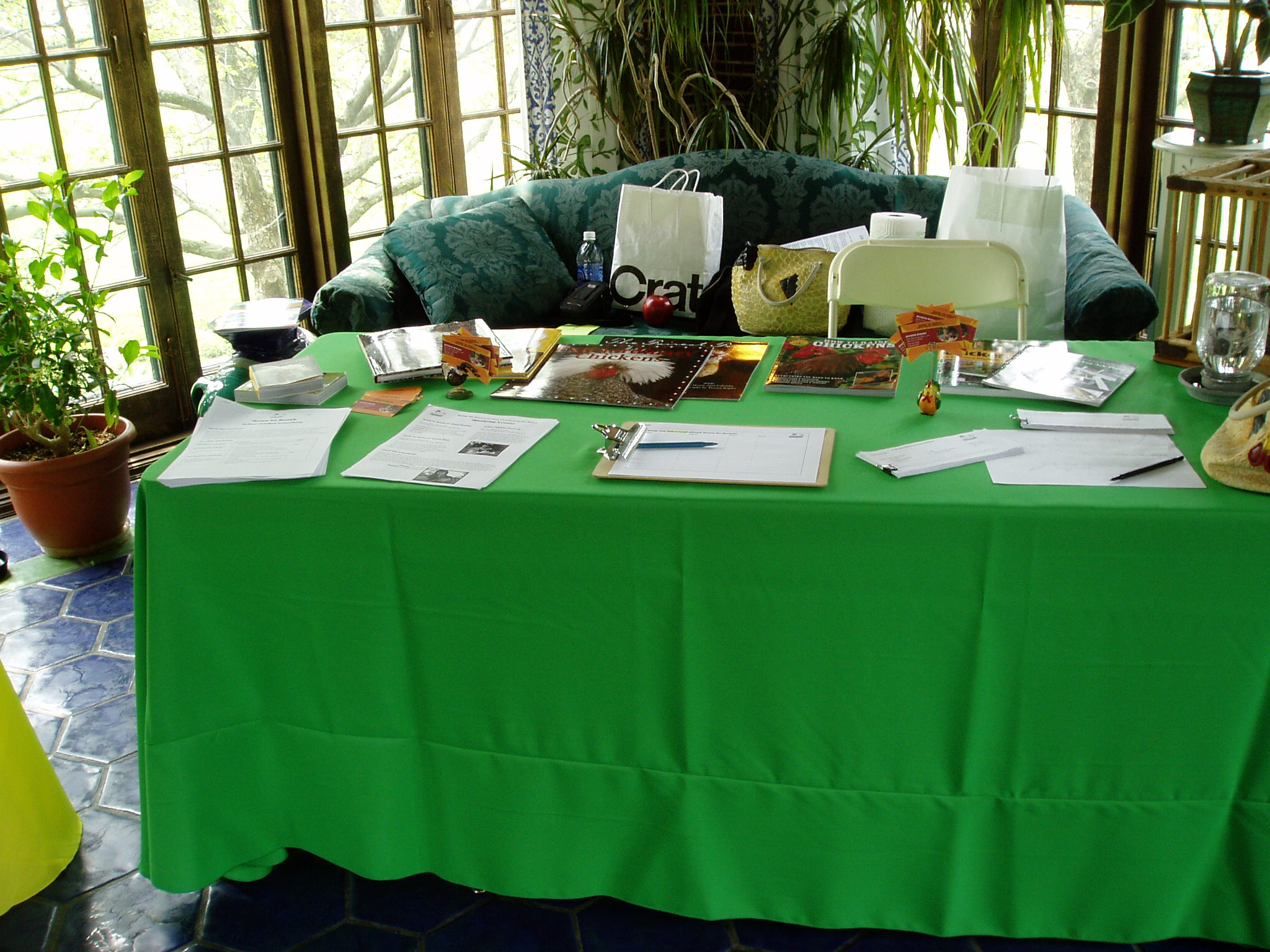
Home to Roost had a great time yesterday at Cheney Mansion in Oak Park! Oak Park chicken owner Emily Wilkes and her two hens, Joe Schmoe and Dinosaur, joined us. They were housed in my grandfather’s antique chicken crate. I brought along sign-up sheets and books with coop designs and information on chicken-raising and breeds. Also on display were several books and calendars by my favorite chicken photographer, Stephen Green-Armytage.

My display

Home to Roost was in the solarium at Cheney Mansion. I brought along sign-up sheets and books with coop designs and information on chicken-raising and breeds. My favorite chicken photographer is Stephen Green-Armytage, and I brought along some of his books and calendars.

Drawing a Crowd – and Lots of Questions!

The chickens were a big hit, and the event was non-stop from 1 PM to 4 PM. People had various questions:

Can a hen lay eggs without a rooster? (Yes, they just will not be fertilized eggs.)

Can you eat a fertilized egg? (Yes. If the hen does not start to incubate the egg, cell division will not occur.)

Can chickens fly? (Yes – kind of. They are not very good fliers!)

What do you think about this coop design?

Margot and I discussed her garage coop plans.

Do you have chickens? (Unfortunately, no – I only have parakeets and an orphaned cockatiel in my apartment.)

Can you have chickens in an apartment? (No. Their poop has too much ammonia and is very smelly in enclosed spaces.)


Well-Behaved Hens
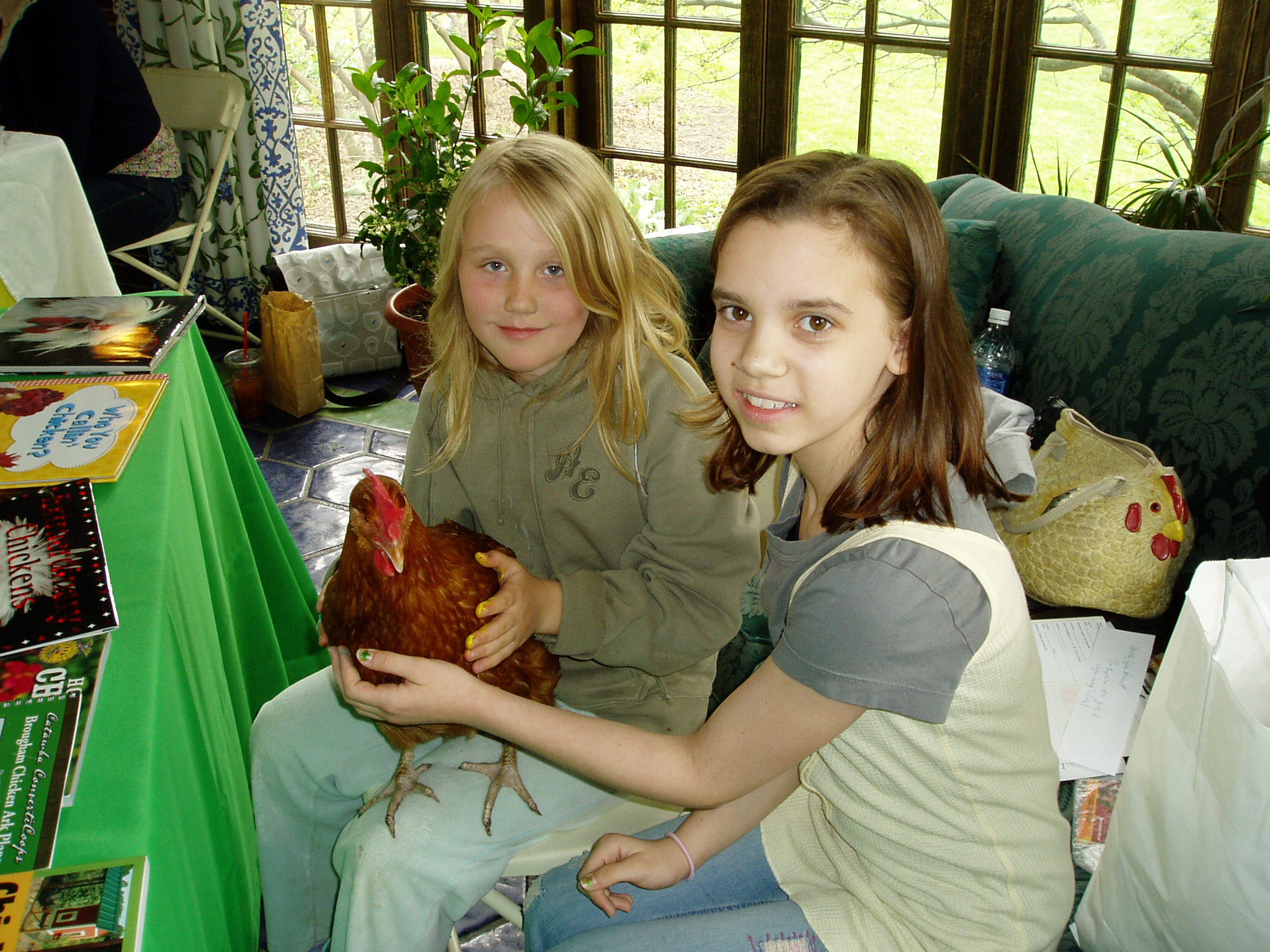
Emily’s chickens were well behaved and did well being handled by kids and adults alike.

A family checks out Emily's buff Orpington!

I gave a brief chicken anatomy lesson for the kids, too.  We met Beatrice and her mom, who were thinking about getting chickens.

Beatrice had a seat and held a hen on her lap. When one chicken jumped up on the table, it scared her a bit, but she asked to hold the hen again!

Beatrice did very well holding Emily's hens!

The Cluck-Like-a-Chicken Contest

Patricia won the cluck-like-a-chicken contest with her loud and animated clucking!

Since I was the resident chicken expert in the house, I was called upon to judge the Cluck-like-a-Chicken Contest. People of all ages lined up to present their best chicken communication. The winner was Patricia, who animatedly clucked and flapped her wings.

The close runner-up winner was Liam, who had very nice tone quality. His mother (of Green Home Experts) informed me that each family member has his or her own cluck, so Liam gets a lot of practice. The prizes were organic eggs!
Raffle Drawing
At the end of the day, we mixed up the raffle tickets (which were in my spare chicken purse!).

And the winner is... Emily selects a winner from the chicken purse!

Emily drew a winner’s name from the purse. This person will receive one free service from Home to Roost.

A Great Day!

Emily, her hens, and I had a great day at Cheney’s Green Sunday! The event organizers enjoyed having us as well, and people enjoyed learning more about chickens!

What do you want to learn about chickens?


Home to Roost offers informative workshops and classes on chicken care. What do you want to know?

Take our poll and submit your own ideas. If more than one topic, list in them all in the Other spot.

Hard crop emergency call


Last night I went out on a call for a chicken that had a hard crop. I suspected impacted crop.

The owner said the crop had been hard for a while and that she was lethargic and hadn’t eaten in a while. He isolated her in a carrier in the basement and put a heater in to keep her comfortable.

I arrived, expecting to treat a crop impaction, but instead found that Hildegard the buff Orpington was listless and lethargic. She had an empty crop and lots of poop. So the crop and GI system were doing ok; however, she had not eaten since the owner isolated her.

I gave her an external exam and checked the poop. There was nothing abnormal in the external exam, but the poop yielded a stone and a full kernel of wheat, which made me wonder if there was something wrong with the gizzard. It also looked like she had chipped her beak.

My recommendation was that the owners keep the hen warm and isolated and see an avian veterinarian; without the ability to know what was going on internally, this was beyond me. I recommended several avian vets in the area and asked that the owner follow up with me.

It’s always difficult for me when I am unable to help a chicken. They can stymie even the avian vets; birds are good at hiding sickness, and by the time you know they are not feeling well, it’s too late. More on this topic (subclinical illnesses) to come!

Home to Roost at Manor Garden Club May 17


I’ll be presenting at the Manor Garden Club at the Luther Memorial Church in Ravenswood, Chicago, on May 17, Monday evening.

The meeting starts at 7:30, presentation at 8:15. I plan to talk about chickens and composting. Details to come!

Handling chicks


Handle your chicks from the time they come home, and as adults they will be well adjusted to human touch.

So you just got those cute, fuzzy little chicks! You’ll also note that those tiny little feet get poop all over them! So you may not want to handle your chicks.

It’s very important to handle chicks from the time they are little. You should pick them up,  touch their wings, examine their beak and vent, and hold them in different positions. The reason is very practical–if your chicken needs to be caught or handled as an adult, it will already be habituated to human touch.

Remember, chickens are a prey species, so they are skittish by nature. Careful nurture can change that.

Sometimes an  injured or scared bird needs to be recaptured. Adding fear of human touch to that equation will create one freaked-out bird, and she may make things worse or injure herself by trying to escape from you!

It is also important that a bird be handled as a chick because she will respond better to human contact if you have to treat or medicate.

When handling your chicks, though, keep in mind that birds have no diaphragm. Humans have a muscle that helps the rib cage expand to breathe in. Birds do not. This means that if you compress a bird’s rib cage, it CANNOT expand its rib cage to pull in oxygenated air. If you (or your child!) hold a bird too tightly, you can suffocate it. As you handle your chicks, hold them firmly but loosely, with extra space in your hand to allow them to breathe.

Also, do not let chicks run around on the floor where people (or your children!) might be walking. They are very fast and can get underfoot quite quickly!

So remember these tips when you get your mini-flock:

  • Handle chicks often, everyday if possible.
  • Don’t squeeze!
  • Keep them out from under foot.

You will have happy, healthy hens who aren’t afraid to be caught, picked up, examined, or petted!

Chicken panel at Navy Pier Green Festival May 22


Do you want to

  • know more about keeping chickens?
  • have more chicken-keeping resources?
  • connect with other chicken keepers?

Come to the Green Festival at Navy Pier on May 22 and see Home to Roost in the chicken panel at 2 PM!

Martha Boyd from Angelic Organics (www.learngrowconnect.org) is leading a panel discussion about

  • chickens in Chicago
  • chicken care basics
  • backyard chicken-keeping experiences and advice
  • egg business
  • chicken supply delivery business
  • resources for urban chicken owners

Come talk to us after the event.