Sexing Chicks: Why It’s Important


Chick-buying season is nearly here! What do you need to know before you head out to the feed store or purchase mail-order chicks?

It is very difficult to tell the gender of newly hatched chicks, and you don’t want to wind up with 50% roosters in your flock. Nothing against the boys, but many communities have prohibitions against roosters. When they begin to crow in the early morning, and randomly throughout the day, you or your neighbors may have issues. Also, chickens don’t pair-bond, and one rooster will have a harem of hens. Two roosters in a flock can mean a fight to the death—or a seriously injured rooster.

If you do wind up with a surprise rooster that you can’t keep, finding a home for him can be difficult. See my blog post, What to Do with the Roos? If you can’t keep the boys, make sure you purchase properly sexed chicks, so you have every likelihood of having only pullets (female chicks).

Important Questions to Ask

  • First, ask the seller if their chicks have been sexed. You want to avoid Straight Run, which means that no effort is made to separate the boys from the girls. Fifty percent of straight-run chicks will be male.
  • Then, ask if the seller will take back any surprise roosters. Not all feed stores/mail-order companies will do this, however.

Methods of Sexing Chicks

Here is some information on sexing techniques and their effectiveness.

  1. Feather Sexing
    In some breeds, the sex of a chick can be determined by the rate of growth of its wing feathers. The method is largely depended on breed. Sometimes the differences are slight, and this is not a 100% certain way of determining gender.
  2. Vent Sexing
    This method involves examining the vent for the male “eminence” or genital organ. It is difficult to do on chickens and requires professional training. Even the pros do not have a 100% accuracy rate! Most hatcheries use vent sexing, but even so, you may get a surprise boy!
  3. Color Sexing / Autosexing
    Some breeds of chickens have been bred to make gender differences more obvious. These methods involve breeding chicks that will indicate their sex by the appearance of their down. Males may be lighter in color, or they may have a pale spot on the head. These breeds are called sex-linked crosses.
  4. Visual Sexing
    If you hatch your own chicks and don’t have color-sexed or auto-sexing breeds, you should be able to tell the sex between four and six weeks of age. This is when the secondary sex characteristics begin to occur: males will have a larger comb and wattles and start to practice crowing. At 8 to 10 weeks, the hackle, saddle, and sickle feathers will become noticeably different.

More information about sexing chicks is available from this Purina Mills article, How to Sex Baby Chicks.

Even if you purchase properly sexed chicks, keep in mind that no method is 100% accurate. Make sure to have a plan in case you accidentally receive a rooster and cannot keep him.
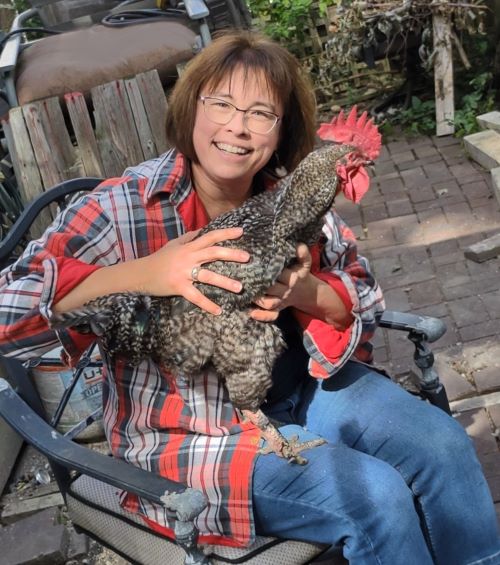
A rooster I met during the Windy City Coop Tour in 2021. This photo shows the enlarged comb and wattles characteristic of mature roosters. These secondary sexual characteristics do not become apparent until a young rooster is between 4 and 6 weeks of age.

Residents of Key West Cry “Fowl” over Feral Chickens


A rooster roaming free in Key West.

Visitors to Key West can’t help but notice the chickens that wander around town, pecking at discarded French fries and potato chips and nesting in alleys and vacant lots. They make for charming tourist photo ops, but some of the locals are understandably annoyed by the frequent crowing at all hours, chicken droppings on sidewalks and door stoops, and even the threatening behavior of some of the more aggressive roosters.

These feral chickens are well fed–even without scraps of food from humans, they can feast on Florida’s abundant foliage and insect population. But some residents purchase bags of food for the critters, and feeding the chickens is a favorite tourist activity. The result: an exploding feral chicken population.

The wild chickens are considered an invasive species. As the chicken population spreads up the Keys, there is concern that they could crowd out some of the last remaining native species of the islands. As Tom Sweets, Executive Director of the Florida Wildlife Center points out, chickens don’t have many natural predators in Key West.

“We get hawks migrating through but they don’t really get the numbers down,” he said in an article for WFSU News.

On the other hand, organic farmers in the Keys welcome the chickens, because they are excellent foragers for bugs that could damage their crops, and their droppings make excellent fertilizer.

Enough people complained to local government about the birds that the Key West City Commission recently passed an ordinance prohibiting the feeding of feral chickens within city limits.

We at Home to Roost approve of this approach to controlling the chicken population, especially because feeding chickens fast food and random table scraps is bad for their health. Chickens are very good at foraging for their own food, especially in a lush environment like Key West.

Another solution that locals favor is to trap the chickens (without harming them) and bring them to the Key West Wildlife Center. Then the chickens are transported to farms and stables on the Florida mainland.

The chicken has become an unofficial symbol of the island, frequently seen on t-shirts, caps, and artwork for sale in Key West boutiques. When I visited the island a few years ago, I fondly remember the Funky Chicken Store. Visiting a vacation area where the chickens run free has its charms, as long as the local chicken population is managed responsibly.

Register Now for Chicken Coop Basics – Online on February 16!


I will present Chicken Coop Basics, the next class in my series for Villa Park Public Library, on February 16, 6:30pm – 8:30pm. I hope you can join me for this free online class!

Register now at this link: Chicken Coop Basics – Online

This class addresses what you need to know about building a safe and comfortable home for your hens. You’ll learn the basic housing needs of backyard birds. Find out the essential components of a coop, construction materials to choose and avoid, important construction tips, and see different coop styles.

When Should I Call the Vet?


When a member of your flock is injured or sick, sometimes it is difficult to know if veterinary care is needed. A predator may have attacked your chicken, and you are not sure if the cuts or scrapes will heal on their own, or if there are worse injuries to attend to. Perhaps your chicken is showing signs of a respiratory infection. Or that bad case of bumblefoot is not responding to home treatments.

While not trained in veterinary medicine, Home to Roost provides “in-between” services for hurt or sick birds that require assistance. We provide first aid and simple at-home, animal husbandry-related solutions; however, for more complicated issues, we will refer you to avian veterinarians for diagnosis and treatment. Visit the “Home to Roost Services” tab of my blog for more information.

Do you need to see a vet? Here are some guidelines:

1. Does your bird have an injury that is life threatening or that involves a wing or leg?  

Any kind of trauma, such as a predator attack, broken bone, amputated limb, or deep wounds, requires a visit to the vet. In these cases, your chicken may need pain medication and/or antibiotics. A trained avian veterinarian should know how to assess the bird’s condition and treat appropriately.

2. Does your bird have a respiratory infection that is not improving?

Signs that suggest a respiratory infection include sneezing, coughing, rattling, wheezing, and mucus coming from your bird’s nares (nostrils). Bubbles in the corner of the eyes can also suggest a respiratory infection. Birds have a complex respiratory system that involves nine air sacs positioned around the body. Because of this complicated system, respiratory infections may not resolve on their own and may require antibiotic treatment. While you might be able to access antibiotics for chickens, antibiotics must be prescribed by a veterinarian.

3. Does your bird have bumblefoot (pododermatitis) that is not improving?

If Epsom salts soaks and drawing salves are not working on your chicken’s bumblefoot, do not perform surgery on your own. Surgery is a delicate procedure that may result in damage to the bird’s foot. Surgery is also very painful, and your bird will need pain medication.

4. Does your bird need antibiotics?

Antibiotics are prescribed based on the kind of infection, the location of the infection, and the purpose of the bird. Some medications are not approved for use in chickens. An avian veterinarian will know what medication to use and how to administer it (injection, drinking water, with a syringe, etc.). It is important to limit unnecessary use of antibiotics; if antibiotics are given too often, bacteria can develop resistance to them, and infections may not respond to future treatment.

5. Does your bird need pain management?

How can you tell when a chicken is in pain? Chickens tend to hide pain to avoid predation and prevent being excluded from the flock. They also do not have facial expressions that can be easily read. A chicken in pain may withdraw from the rest of the flock, show little interest in food, or stop vocalizing. Limping also may be a sign of pain, as well as breathing hard, panting, or a heartbeat that is faster than normal. Chickens often peck at a painful area. Birds that require pain management should be taken to a veterinarian.

Avian Vets in the Chicago Area

If you live in the Chicago area and have a chicken that needs medical attention, I maintain a list of recommended avian vets in the area. Go to the Resources tab of my blog. Tell these practices that Home to Roost sent you!

Jennifer Murtoff
Photo by Liz McCrory, kosmicstudio.org

UPDATE: Chicken-keeping classes with Home to Roost change to online format


UPDATE 1/7/22: The two chicken classes I am teaching for Villa Park Public Library will now be held ONLINE via Zoom, instead of in-person. I hope you can join me for these virtual events!

Basic Backyard Chicken Keeping – January 19, 2022, 6:30pm – 8:30pm

Please register for this online program (at the link above) and you will receive a link to join on January 19.

This class is designed for curious folks who are considering getting chickens, as well as for those who already have their own birds. Learn how to find local laws, choose and raise chicks, and care for adult birds.

NOTE: A license is necessary to keep hens in Villa Park, IL. Here are links to the Village’s guidelines & ordinance, and the license application:

CHICKEN (HEN) LICENSE Guidelines & Ordinance

CHICKEN (HEN) KEEPING LICENCE APPLICATION


My next class in the Villa Park Library series, about chicken coops, will also be held online:

Chicken Coop Basics – February 16, 2022 6:30pm – 8:30pm

Please register for this online program (at the link above) and you will receive a link to join on February 16.

This class addresses what you need to know about building a safe and comfortable home for your hens. You’ll learn the basic housing needs of backyard birds. Find out the essential components of a coop, construction materials to choose and avoid, important construction tips, and see different coop styles.

Photo by Liz McCrory of kosmicstudio.org

Hen Looking for Home Update: A Home Has Been Found!!


12/16/21 UPDATE: Isa has a new home!!

HELP FIND A HOME FOR “ISA” THE ISA BROWN HEN!

Isa the brown hen

Name: Isa
Age/Breed: ~1 year, 7 month old Isa Brown Hen
Description: Spunky and healthy Isa Brown hen that’s a reliable, daily layer.
Location: Chicago, south side
Reason for Re-homing: Our small organization just lost our other hen (a Plymouth Blue Rock) who had persistent health issues with laying for a long time. We are a nonprofit organization that doesn’t have the staffing or space to take other chicks/hens at this time of year. We know that a single hen is not a happy hen… and are concerned about keeping her warm enough through the coldest parts of winter all by herself. We have feed and other supplies.

Give the gift of chicken care! Gift certificates for chicken consulting now available


Photo courtesy Jennifer Gilstrap

You need the perfect holiday gift for the chicken keeper who has everything! Home to Roost LLC is now offering gift certificates for in-home and Zoom consultations. Chicken consultant Jennifer Murtoff will help the chicken keeper in your life with issues related to chicks, adult birds, coops, health, and nutrition. Consulting sessions are 1 hour in length.

1 Chicken Consulting Session: $63

2 Chicken Consulting Sessions: $124

3 Consulting Sessions: $155 (a $30 savings!)

Please note that fees for mileage and additional time may apply and are chargeable to recipient.

Please contact me using the form below if you are interested in purchasing a gift certificate! I will email you instructions for purchasing a certificate using PayPal (I can’t accept payment through my blog).

Yes, I am interested in purchasing a gift certificate! Please send me more information.

← Back

Thank you for your response. ✨

Thank you for supporting backyard chicken keeping in the city! Warm holiday wishes to you from Home to Roost.

Listen to Home to Roost, live on WBEZ, Nov. 2 2021!


Home to Roost will be LIVE on WBEZ tomorrow, November 2 at 12:45 pm. Tune in to 91.5 FM or listen on the WBEZ website.


I will be live with chicken keeper Tim Norris on WBEZ’s Reset program, talking about raising chickens in Chicago. I teamed up with Tim and his flock of 25 chickens during the Windy City Coop Tour in September, and am looking forward to talking chickens with him once again!

Visit my booth at the Green Living Expo, held online Nov. 6!


If you’re interested in learning how to live more sustainably, join us for the 14th annual Green Living Expo, held online on November 6! Come anytime betweeen 10am and 5pm. I will have a virtual booth at the Expo and also speak about chicken keeping at 3:30pm. When you visit the Home to Roost booth, download our coupon for 25% off a 1-hour session of chicken consulting!

Yes, this will be an adventure, both for us and anyone who attends! We have never participated in an online expo before.

Visit www.mchenry.edu/greenexpo to register and view the agenda for the expo. There will be four unique tracks:

Renewable Energy
Waste Reduction
Food and Farming
Fun and Recreation

Plus, sessions throughout the day focusing on areas of importance to our audience. Hope to see you there!

UPDATE: Hens looking for home


As of 11/16/21, these 3 hens are still available. The hens are 2 1/2 years old.

Contact Mary: mmarcano866@gmail.com.

Looking to rehome 3 hens as my daughter moved out, and I will be moving soon. We are looking to relocate 1 Welsummer, 1 Easter Egger, and 1 cream legbar to a spacious coop, as they are older hens and like room to roost. All 3 raised together since birth. 

Contact Mary: mmarcano866@gmail.com