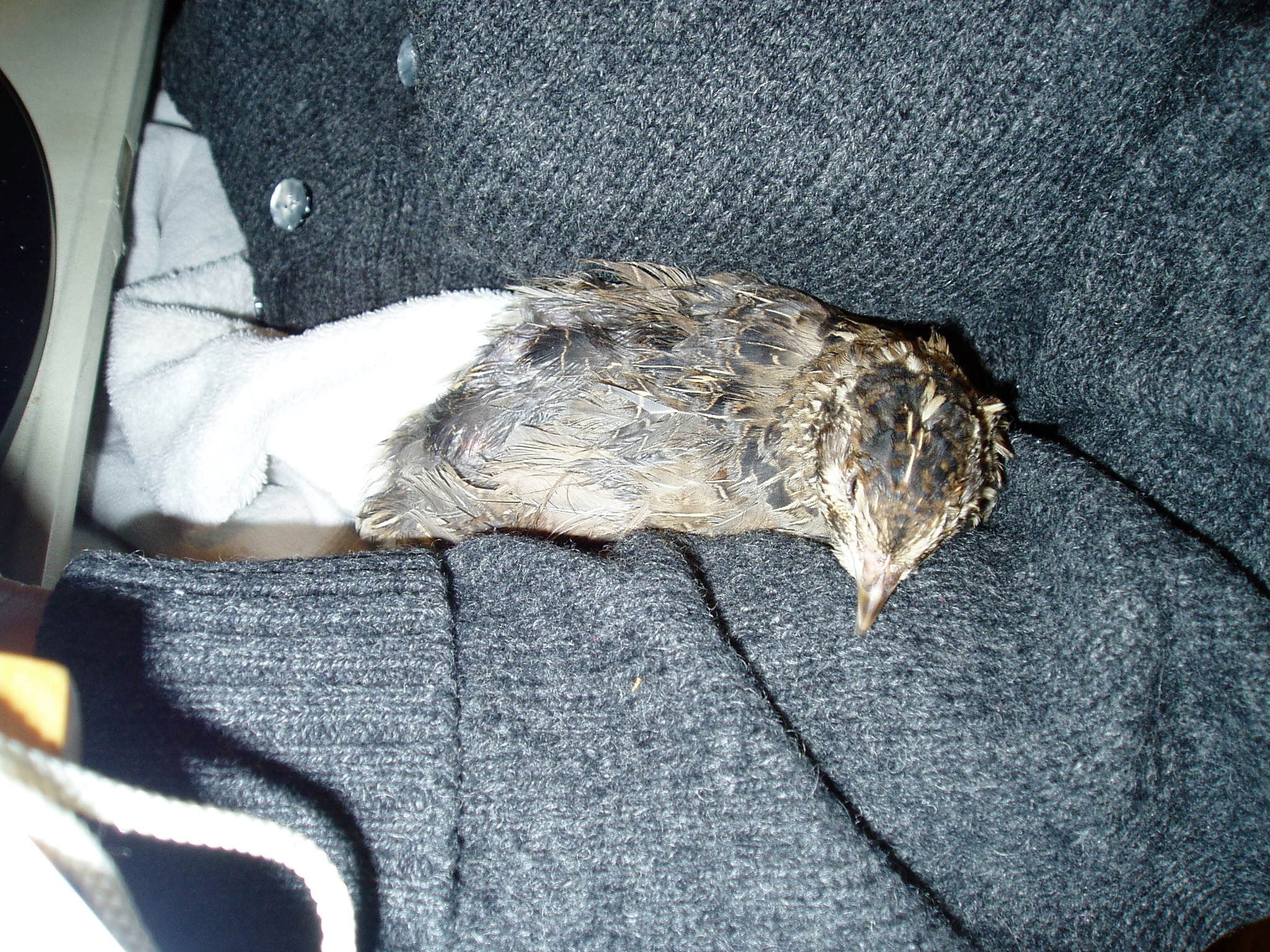
Update on Penny the Quail, or The Adventures of Penny the Quail in Chicagoland


It's a big world for a little quail.

You’ll all no doubt recall the little quail who found me on May 8 (See my May 9 post). Well, Penny has made a home for herself here, despite her eating habits.  Continue reading to learn more about that!

Medical News

Penny is doing quite well, and her feathers on her back are growing in nicely! She was treated for a liver infection, and I think we’ve got that under control.The vet said that the lump on her back was her spine, which is twisted, probably due to malnourishment as a chick.

Note: I had a bit of an aspiration pneumonia scare while giving her meds from a syringe. I ended up soaking the meds into a tiny bit of feed, letting it dry, then seeing that she ate it all before feeding her more.

Penny contemplates the world from three stories up. The feather loss on her rump is quite clear in this shot, taken right after I got her (or after she found me).

DIRT!!

Given her behaviors (scratching furiously and fluffing her feathers and wings repeatedly while sitting down), I figured she wanted to dust. Then one day, while  looking out the window, she spied the dirt in my potted basil plant and took a dive into it!

So I took the hint and headed out to find dirt. I didn’t want potting soil – too many additives – so I headed into Schauer’s Hardware in River Forest and asked for dirt, not potting soil, just dirt. The guy behind the counter said, “Oh, you want topsoil? Well, we have a 40-lb bag in the back.”

“No,” I said, “that’s too much. I have a pet quail, and I want it so she can take a dustbath.”

It took a bit for that to register, but the look was priceless. “Aww, that’s the cutest thing I’ve ever heard! We’re gonna put it on Facebook!”

I guess cute has its moments. They sent me home with a free partially opened bag of topsoil. I made the quail a dirt box. Penny was elated.

You can see that Penny's feathers are growing in nicely.

I’ll have the greens salad, please.

Penny is becoming quite the connoisseur of houseplants. I looked over one day to find her under the peace lily. She had snipped off a whole leaf, and it lay between her feet, a large verdant trophy. She looked up at me as if to say, “Honest, Mom, it just fell off.” I’ve moved the peace lily to higher ground and bought a cage for my little salad connoisseur, but the prayer plant also came under fire. (Good thing the dieffenbachia is out of reach – it’s toxic to birds.)

Penny's quail condo with dirt box veranda

So I got the hint and bought her parsley. She was elated. Then the fatal error occurred –  I gave her Romaine lettuce. It’s now her favorite. If I dare put parsley in her dish, I get a look that’s somewhere between disdain and ennui, but closer to disdain. Romaine earns me the quail version of the happy dance, which is endlessly entertaining. Seriously. I have friends over, and we watch it and crack up laughing. Needless to say, I don’t have cable.

World’s Luckiest Quail Gives Back

Since she now had a cage, a dirt box and topsoil, and greens salad, Penny decided to give back. She was quite antsy for about an hour one afternoon, then suddenly quieted down. I looked over a few minutes later, and there lay a lovely little speckled egg! I’m saving them until I get a dozen. Maybe that will give me a decent omelette.

Quail eggs with chicken egg for size
Home to Roost’s encore in the Wednesday Journal


Well, they just couldn’t get enough! Here is the Wednesday Journal’s “second helping!”

Home to Roost Makes the Paper!


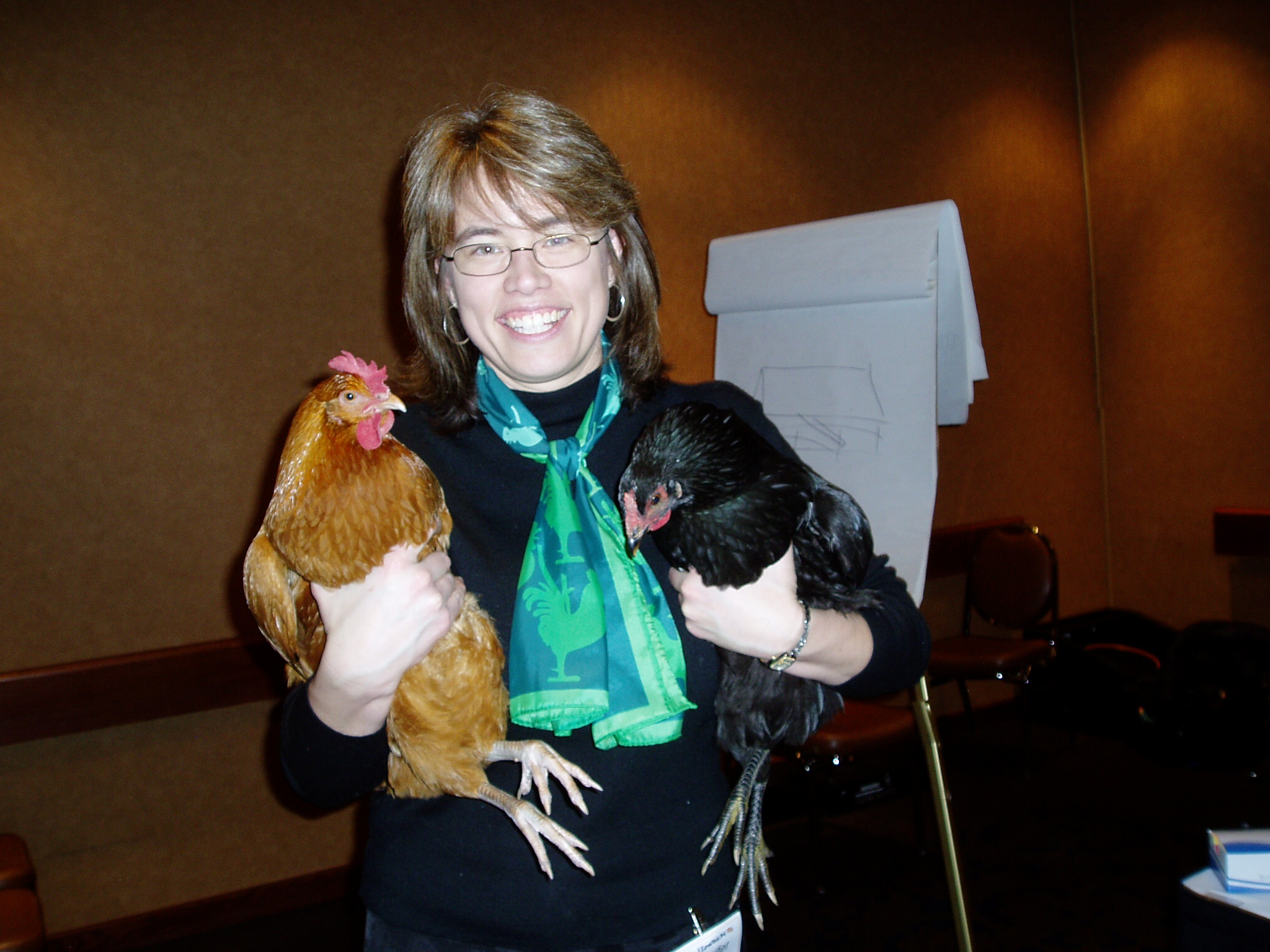
Home to Roost is taking the press by storm! Ok, well, at least the Oak Park press. The Wednesday Journal decided that urban chickens was something to cluck about and featured two hot chicks and me (oh, wait, that would be THREE hot chicks – but I don’t need a heat lamp!) in this week’s edition.

A few months ago, Oak Parker Bruce Caughran asked Alcuin Middle School students to build a chicken ark for him. The students completed the project, and Bruce approached me to purchase the supplies and chicks (my Busy Biddies Add-On Service!) and provide my New Babies Consultation to teach him and his daughter about chicks. He set up the completed ark (very nice, I might add!) in his yard and invited the students who built it to come, as well as reporter Terry Dean.

You can read more details about the event here and a little bit of random chicken trivia here!

Home to Roost’s own press crew covered the event, but they have been running around like chickens… oh, wait. Bad metaphor. Let’s just say they’ve been busy. I’m hoping to post my own coverage soon!

Home to Roost at Navy Pier’s Green Fest


Come out for the chicken panel at the Green Festival on Navy Pier!

Saturday, May 22 at 2:00pm in the Green Homes Pavilion

Martha Boyd from Angelic Organics is leading a panel discussion about chickens in Chicago, chicken care basics, backyard chicken-keeping experiences and advice, the egg business, chicken supply delivery business, and resources for urban chicken owners.

Meet the panelists after the discussion to ask questions!

Chickenomics


The following are common questions about raising chickens:

  • “So how much money will having my own chickens save me?”
  • “Will having my own hens benefit me financially?”
  • “Is having chickens a cost-effective strategy?”

The answer varies widely, and Joshua Levin, who has chickens in New York City, does a good job examining the economics in his article “Backyard Chicken Economics: Are They Actually Cost Effective?”

Here is a brief summary:

Set-Up Costs: $121 (chicken wire, waterer, feeder, grit, hens)

Per-Month Variable Costs: $31.50 (organic feed) or $13.50 (non-organic feed)

Value Produced per Month: $27.66 (40 eggs = $20, fertilizer = $7.66)

In Levin’s estimation, the cost of feed determines whether or not your operation is profitable. If you use non-organic feed, you will break even in 6 months; organic feed, 14 months.

Levin’s Cost-Saving Strategies

  • Build the coop yourself
  • Procure free items – structure for coop, wire, other building materials
  • Buy non-organic feed
  • Supplement the hens’ diet with table scraps (do this with caution, as lots of roughage can lead to crop impaction and sour crop) and allow them to free range.
  • Use newspaper as bedding rather than wood chips (but know that newspaper packs more easily, gets wet more easily, and has to be changed more often to prevent mold, which can cause aspergillosis – but it can be composted more readily)
  • Add another hen, which does not considerably change the costs.
  • Harvest your chicken manure.

Follow-Up Comment

A follow-up comment on Levin’s article, posted by Patricia Foreman, gave the following as positive reasons to raise hens that are not figured into Levin’s purely capitalistic perspective:

  1. Contribute to the backyard agriculture movement by perpetuating knowledge of animal husbandry and local food production
  2. Recycle waste to keep it from landfills by using chickens to recycle biomass
  3. Reduce fossil fuel use and carbon footprint by reducing the amount of oil we use to feed ourselves in packaging, transportation, and production
  4. Prepare for emergencies by having a food source on hand

It’s a great article; if you found my summary helpful, check out the article at GoodEater Collaborative.

Levin has chickens in New York City

Home to Roost at Manor Garden Club


I’ll be speaking at the Manor Garden Club meeting on Monday, May 17, about the basics of backyard chickens.

The club meeting starts at 7:30, followed by refreshments and a book raffle between the meeting and my talk. The talk will begin around 8:15-8:30 PM.

The meeting will be at Luther Memorial Church at 2500 West Wilson (at Campbell).  Entry is through the side Campbell street door.  Go down a few steps to the main room.  Street parking – which is tighter nowadays since the schoolyard went all green.

The meeting is open to the public, and there is no charge.

It’s a chicken… No, it’s a quail!


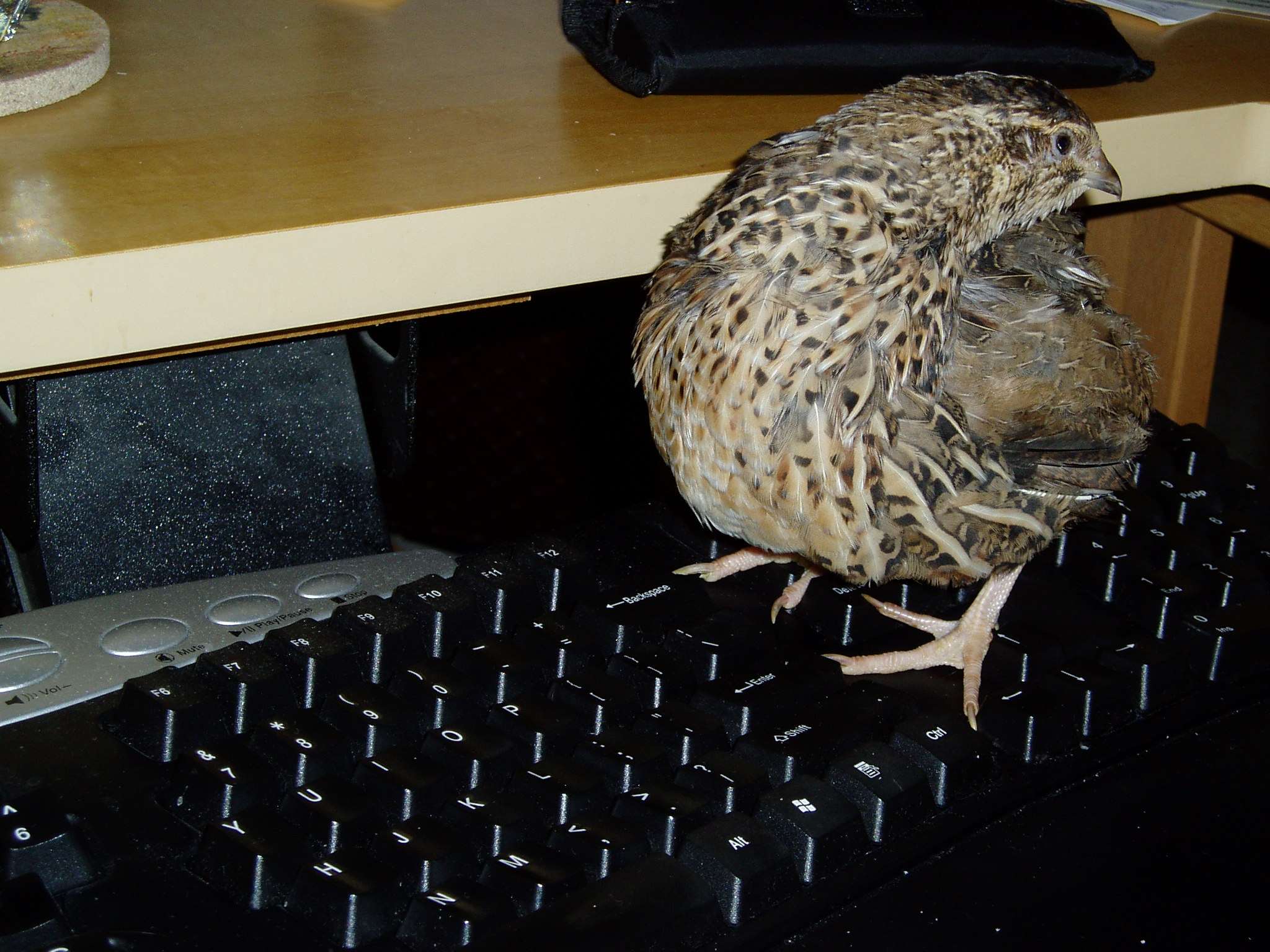
My new office assistant


On Friday I got a call about a chicken that was found in a forest preserve. I asked the person how big, what it looked like, what size the comb was. “Well, it’s brown with markings, and it doesn’t have a comb.”

Hmmm… I decided that was not a chicken! When he brought the bird over, and it was a lovely little Japanese coturnix quail hen!

About Coturnix

The word coturnix is Latin, and the Spanish word for quail is codorniz, which is derived by regular sound change (sorry, I had to work in linguistics!). Japanese coturnix quail are not indigenous to the United States, so wildlife rescues will not take them.

I used to hatch them when I was growing up. Incubation takes 17 days, and the chicks hatch all at once – you lift the incubator lid, and it looks like black and tan popcorn! The chicks have black and tan “racing stripes” – very appropriate since the babies are very fast and very high energy! They will sometimes trample each other, so they need ample room in a brooder box. Weak or slow chicks should be removed from the box that holds the lively ones until they are “up to speed.”

Coturnix are raised for their eggs and meat, which are considered gourmet. You can read more about coturnix here and see pictures of eggs and babies here and here.

Back to the Quail…

Her back end had the feathers torn off, as if she’d been run over by a mower or caught by a dog. The skin was fine, and the feathers were growing back. As I was carrying her in, tucked against my chest, she started making these little contented quail noises. She was cooing!

I examined her away from the parakeets to prevent spread of disease and noticed that her eyes were rheumy looking and irritated; she had been scratching them. I put antibiotic ophthalmic ointment on them and washed my hands thoroughly. She was not lice infested and was eating and drinking well, so I put her in my bird carrying cage.


The little quail loves to snuggle in my arm as I work on the computer!


She loves to snuggle in the crook of my arms as I work at the computer and make little happy quail noises! We’re going for a vet check-up on Wednesday.

It’s a Hen… or Maybe Not! Gender-Bending Chickens


One of your hens suddenly stops laying. Her comb and wattles enlarge, and (s)he starts crowing… WHAT is going on?

Weird science, yes. And other people have found it weird, but they did not consider it to be science—Gail Damerow reports in The Chicken Health Handbook that, in 1474, a rooster named Basel was burned at the stake for laying eggs.

Normal Physiology

A hen has two ovaries. Normally the left ovary atrophies during development of the chick, and only the right ovary produces eggs. However, in some rare and bizarre cases, alterations in the bird’s ovaries cause sex hormone changes.

Female Changing to Male

On rare occasions, the right ovary ceases normal function—perhaps due to a tumor or an infection, and the left ovary becomes functional, sometimes producing testosterone. This hormone switch causes the bird to develop typically male features: larger comb and wattles, male plumage, male vocalization.

For some fowl gender-benders, check out these photos.

Male Changing to Female

Then there is the recently reported bizarre story of the Italian rooster, Gianni, whose flock of hens was lost to a fox raid. Gianni became Gianna and started producing eggs!

The article cites a “bizarre DNA mix”; however, I posit that the bird’s genetics are not the issue. The bird’s genotype did not change; only the phenotype (expression of the genes) is altered.

Perhaps the right ovary was initially nonproductive, causing a testosterone-laden female bird with male sex characteristics. The right ovary then decided to quit the picket lines and return to production, et voilà – a rooster-turned-hen!

However, further reading indicates that it is highly unlikely that these birds will ever assume the full reproductive roles of the newly acquired gender.

Practically Speaking

For those of you who are content with your two backyard hens who quietly sing and cackle occasionally, no need to panic about being woken in the middle of the night to crowing. This is not a common phenomenon! But if Henrietta suddenly starts acting like Henry, please don’t burn him/her at the stake. The only devilry going on is hormonal!

Sources

Daily Mail Reporter. April 22, 2010. “Now I’m a chick! Gianni the gender-bending cockerel starts to lay eggs, baffling scientists.”http://www.dailymail.co.uk/news/worldnews/article-1267691/Gianni-gender-bending-rooster-starts-lay-eggs.html

Damerow, Gail. 1994. The Chicken Health Handbook. Storey Publishing: North Adams, MA.

Jacob, J. and F. Ben Mather. “Sex reversal in chickens.” Factsheet PS-53. University of Florida Extension: Institute of Food and Agricultural Science.

“Sex Change in Poultry.” Feathersite.com. http://www.feathersite.com/Poultry/BRKChange.html

Case Study: Birds and Subclinical Illness


Subclinical Illness

In my workshop on Sunday, I discussed subclinical illness, which is the natural tendency of certain animals, birds included, to hide signs of illness until their bodies can no longer handle the stress.

Juliet: Case in Point

Case in point for the day is my geriatric parakeet, Juliet.

Juliet is somewhere around 12 (old for a rescued, seed-fed ‘keet), has difficulty getting around due to a broken leg that didn’t properly heal, and plucks her feathers. She’s not much to look at, but she is spunky and by far my best flier. Despite her issues, I’d noticed a few out-of-the-ordinary things in her behavior:

  1. Runny droppings
  2. Odd swallowing behavior – she seemed to be having difficulty
  3. Increased fluid intake

Otherwise, she seemed fine – flying, vocalizing, fighting with Regina Coeli, my other budgie, and just being a ‘keet. In addition, before I left today for the vet (Chicago Exotics Animal Hospital), her poops became a little more solid, and I didn’t notice the odd swallowing. So I was thinking that it was silly to take her to the vet.

However, after discussing the symptoms with Dr. Grabowski, we came up with causes that could possibly explain some of the symptoms:

  1. Breeding behavior
  2. Diet change
  3. Environmental change
  4. Major organ failure

My behavioral observations were confirmed by a throat swab, which revealed bacteria and yeast. So she and Regina are both on meds (antibiotics, antifungal, and probiotics).

Veterinary Roulette and the Avian Vet Solution

Many times, treating birds is like Russian roulette – you just take your best guess – or as Gail Damerow says in the Chicken Health Handbook: “Veterinarians arrive at a probable diagnosis (otherwise known as an educated guess) in part by considering the accumulation of symptoms” (1994, 151).

I’m content to know that my birds are under the care of the avian vets at Chicago Exotics – considering subclinical illness, an educated guess from an avian vet is the best you can get! To paraphrase Leonard McCoy in Star Trek IV, I feel safer about their guesses than most other people’s facts.

(And there, I’ve incorporated Star Trek into my blog!)

Urban Chicken Check-Up


On Sunday, I led the Urban Chicken Check-Up at the Animal Care League in Oak Park. There were 11 people from various neighborhoods.

This hen found a human perch!

What’s Normal, What’s Not

It is important to know what a healthy bird looks like. Birds are flock animals, and the flock will cull the unhealthy members to prevent predator attacks. Birds, therefore, hide their symptoms, leading to subclinical illness. Often you can’t tell a bird is sick until it is near death. The quicker you can determine a bird is ill, the more likely that you can save the bird.

Basic Healthy Hen Signs

It’s important to know how your flock interacts. What’s the pecking order? If you realize your flock is excluding one bird, there is probably a health reason motivating the behavior. Observe behaviors carefully. We talked about the signs of a happy, healthy flock: vocalizing, eating and drinking, doing normal chicken things like dustbathing, and producing normal droppings.

Specific Healthy Hen Signs

Then we moved to specific anatomical characteristics, discussing what was normal and what might indicate disease:

Head: comb, nostrils, ears, eyes, beak, mouth

Body: feathers and molting, posture, preening, keel, vent, abdomen, places to check for lice

Vent: color, how to determine who’s laying and who’s not by looking at the keel and pelvic bones

Legs: proper appearance of leg scales and the footpad

Poop: urates, solid waste, cecal dropping, stress poops

Toweling a Bird

One couple had a bird that was not used to being handled, and I showed them a toweling technique for easier handling. Birds calm down if you place a towel over them. We wrapped legs and wings in the towel, which made it easier to examine the head and vent.

Maisie!

Maisie the hen (see my post about the hen with the soft-shelled egg) came, and she is looking good! Still a bit of residual messy stuff in her fluff, but looking good!

Maisie the hen

Seamus, Emily, chickens, and I had a great day at Earth Fest!

Showing the buff Orpington to a little guy!

Exciting Conversations

I spoke to a number of folks who are interested in getting chickens, exhausted my stack of rate sheets, and allowed a lot of really cute kids to pet a chicken for the first time!

It’s very exciting to see this many people excited about chickens (and I realize as I look at the pictures how excited I am about chickens!)!

I'm not having any fun at all!

I answered question about housing, square footage per bird, chickens and other pets, anatomy, eggs, composting, emergency care, breeds and cold hardiness, coop design, etc.

My favorite question is

Q: Do you eat chicken?

A: Only chickens I don’t know!

My Lovely Assistant

Emily was a wonderful PR rep, despite having just come from ballet, graciously fielding questions about her chickens and carting them from one end of the table to the other!

Emily with Joe Schmoe, the buff Orpington hen

RootRiot Community Garden

Seamus spoke with quite a number of folks about his RootRiot Community Gardens in Austin. The proposed site is between Race and Lake on Waller. Some Austin folks will be meeting in late April/early May to discuss the project. If you’re interested in knowing more, you can find Seamus at www.lowcarbonhome.com and www.environmentalcitizen.net.

Seamus discusses his community garden plans.

Thanks to everyone who stopped by and asked lots of good questions!

Q: Are chickens permitted in Forest Park?

A: No, per the Forest Park Village code: 5-1-2: PROHIBITED ANIMALS: No person shall keep or allow to be kept anywhere within the village any cattle, horses, swine, sheep, goats, ducks, geese, chickens or any other poultry except birds or pigeons used for exhibition or sporting purposes. (Ord. O-48-01, 11-19-2001) http://sterling.webiness.com/codebook/index.php?book_id=422

Q: Is there an egg co-op in the city? Someone is interested in purchasing egg-cess eggs.

A: The Wettsteins bring fresh eggs to the Oak Park Farmers Market. They are right across from the Genesis Growers stand.

One more for my loyal readers:

  • Does anyone in the city have ducks? A few people are interested in ducks!