Chicken keeping and coop building classes! Register now!


Upcoming classes at the Chicago Botanic Garden! Register now to secure your spot.

Saturday, October 14, 2023: Two classes!

Basic Backyard Chicken Keeping
10 am – 12 pm 
Register here: https://www.chicagobotanic.org/adult_education/nature_birding/basic_chicken_keeping?range_start=2023-10-14

Chicken Coop Basics
1:30 – 3:30 pm
Register here: https://www.chicagobotanic.org/adult_education/nature_birding/chicken_coop_basics

Saturday, November 11, 2023
Snow Birds – Winter Care for Chickens
10 am – 12 pm
Register here: https://www.chicagobotanic.org/adult_education/nature_birding/snow_birds_winter_care_chickens

Read more: Chicken keeping and coop building classes! Register now! Read more: Chicken keeping and coop building classes! Register now!

URGENT: Ald. Lopez Again Proposes Ordinance to Affect Chickens: What to Do by Weds., Sept 6


You may recall that in 2019-2020 Ald. Lopez (15th ward) proposed an ordinance to severely limit chickens and other traditional farmed animals in Chicago backyards. He is once again pushing the ordinance, despite significant opposition the first time. The next meeting for the City Council Committee on Environmental Protection and Energy is Weds, Sept. 6!

Here is the official Chicago Chicken Enthusiasts’ statement on this ordinance. A downloadable version with scripts for calls and emails is available here: CCE Statement Opposing Proposed Chicago Livestock Ordinance (O2023-0002993) (1)

CCE Statement Opposing Proposed Chicago Livestock Ordinance (O2023-0002993)
July 19, 2023

Once again, Aldermen Lopez (15th ward) is pushing an ordinance to severely limit livestock in your backyards and neighborhood farms. This ordinance – introduced AGAIN despite significant community opposition in 2019/2020 – hinders the ability of Chicago residents and urban farmers to grow and raise their own food through fees, fines, and unnecessary burdensome regulations. This version of the ordinance also puts animal welfare organizations at risk for caring for abused animals, if they shelter roosters or exceed the limit on livestock. Together as urban agriculture and animal welfare advocates, we oppose the Chicago Livestock Ordinance, O2023-0002993. Contact your Alderman, as well as Ald. Lopez, to oppose this ordinance.

Current regulations protect Chicagoans’ right to raise backyard livestock and practice urban farming that is humane to animals and respectful of neighbors. Existing City of Chicago ordinances already address the potential public health, nuisance, and animal welfare concerns related to raising small farmed animals. The ordinance will create unnecessary regulation by banning roosters, capping the total number of hens at 6, and levying fines in excess of $250 for ordinance violations.

If enacted, this ordinance will threaten the ability of many of our city’s residents and urban farmers to raise their own food and put them at financial risk with costly fees and fines. In addition, the ordinance infringes on the rights of residents by unduly limiting what animals they can keep. These animals are critical community members, offer hands-on ways to learn about ecology and food (in homes, schools and daycare centers), and provide organic pest control and fertilizer, companionship, and other environmental benefits.

We have worked for years to create a supportive system for Chicago’s thriving home and community gardens, urban farms, and livestock keeping. These activities are critical to healthy food access, ecological health, and workforce development in our city. Community education and networking is more effective than blanket regulation to prevent and solve potential problems. Chicago Chicken Enthusiasts supports and promotes equitable land access, affordable water access, ecological resilience, stronger animal protections, and clear business licensing for urban farms. Please contact your Alderman today to oppose the proposed ordinance O2023-0002993.

Signed,
Chicago Chicken Enthusiasts

Discussion Group
Chicago Chicken Enthusiasts on Facebook

Contact your alderman, whether on the License committee or not. To find your ward and alderman, use this link.

  • Explain your reaction to the proposed ordinance as a responsible chicken/livestock keeper.
  • Inform them about backyard chickens and other livestock, and how you manage yours to prevent problems they may have heard about.
  • Invite them to meet you and your animals – assuming you have a good example to show them – if not, work on that! So important!

We encourage people to build relationships with their Alder and Ward staff ahead of urgent issues – so they know you and can go to you for more info. Be among the people they are glad are in the ward making it a better place to live.
Helping Your Chickens Survive the Dog Days of Summer


Help your chickens beat this crazy hot and humid weather!

As the temperatures and humidity soar, you’ll want to help your hens keep cool. A few tips for helping your hens beat the heat. When temperatures reach the mid-80s, your birds will probably start panting. In temperatures above 100, your birds may suffer heatstroke. Here are some tips, excerpted from my class on chickens and heat, to prevent that.

1) Provide fresh, clean water – and lots of it.

2) Freeze 2-liter bottles and put them in the coop to cool it down.

3) Remove excess bedding, which traps heat.

4) Feed a crumble feed, rather than a whole-grain food. Grains generate heat as they are metabolized.

5) Provide shade.

6) Use a fan or a mister.
7) Feed frozen treats (corn, watermelon, canteloupe).
If you notice that the birds are listless and lethargic (signs of heat stress), consider bringing them into a cool basement or to an air-conditioned mudroom (in a dog crate or portable cage). In emergencies, apply cool compresses to comb, wattles, and soles of feet. Chickens do not sweat. Do not cool them down too quickly, which may shock their system.As always, keep an eye on your birds and know what’s normal for them. This will help you catch problems before they become life threatening.

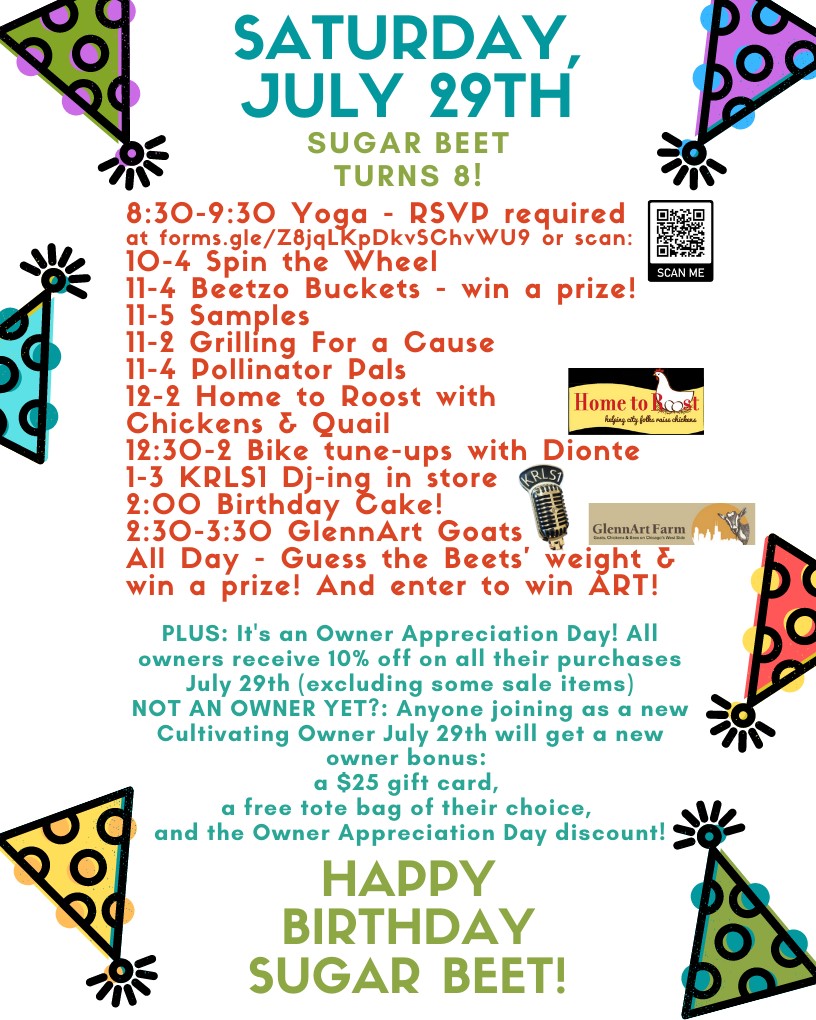
Home to Roost at Sugar Beet, Oak Park, Saturday, 7/29


Join Home to Roost, Sandy the hen, and quail friends as we celebrate Sugar Beet’s eighth anniversary! Come out for this all-day, family-friendly event in Oak Park and check out the co-op!

It’s Flystrike Season


Flystrike is something out of a horror movie. Hot temps and high fly populations mean you should watch out for this awful reminder of the cruelties of nature. Flies love filth, darkeness, and moisture, and sometimes the females lay eggs in moist fecal matter on a chicken’s butt. The eggs hatch in 24 to 48 hours and begin to feed — on the live bird’s flesh. It doesn’t take long for the fly larvae to do irreparable damage and kill your bird. To reduce the risk of this awful fate for your chickens, here are a few tips:

–Reduce fly populations by using fly stickers or pheromone traps.

–Clean up moist droppings and remove sources of water or moist foods that attract flies.

–Monitor your birds closely. Yes, check their butts. Flystrike can be easy to miss.

–Watch for decreased activity level and lack of appetite. Smell is a good clue, too. Off odors often indicate a problem.

–Keep your birds’ butts clean. Yes, you may have to bathe them.

–Watch broody hens closely. They’re vulnerable because they’re in one place all the time. You also may not notice if they’re not feeling well because they sit – all the time!

If one of your birds has flystrike, you will have to bathe it and flush any wounds to get rid of ALL (yes, all) the larvae. And continue monitoring for more that hatch. You’ll also have to clean and monitor the wounds for signs of infection and keep her indoors and away from the other chickens. If the condition has persisted for too long, euthanasia may be the best option.

Corid: A Few Tips


I’ve been seeing a lot of posts on Facebook lately about using Corid. This medication contains amprolium, which is used to treat protozoans called coccidia, or cocci, that cause tiny hemorrhages in the intestinal lining. Cocci are present in soil everywhere. They are most dangerous when your birds are young and have not built up resistance to them. Chicks affected by cocci may have bloody stools, have a “hunched” posture with their heads pulled into their bodies, and be pale, and slow.

There are several ways to combat cocci. First, you can have your birds vaccinated at the hatchery OR you can use medicated feed. If you choose the vaccine, there is no need to use medicated feed. (NOTE: Medicated feed is ONLY medicated for cocci. Also, it does not treat cocci if your birds are sick.)

If your birds do get cocci, you need to treat them immediately with Corid (amprolium). Some things to keep in mind:

  1. Corid is ONLY for coccidiosis (cocci). It’s not an antibiotic. It does not treat anything other than cocci.
  2. Use Corid ONLY if you know your chicks have cocci. It depletes the body of thiamine and can cause serious problems if used unnecessarily.
  3. Do NOT supplement with vitamins if you are giving Corid. The job of Corid is to deplete thiamine (which kills the cocci). If you’re giving vitamins, you’re cancelling out the effects of Corid.
  4. DO follow the package instructions for administering Corid (dosage, method, and length of treatment). Improper administration can kill your birds or cause resistance in cocci.
  5. If Corid does not seem to work, your birds may have a secondary bacterial infection that requires antibiotics. Check with an avian vet.

Here’s hoping none of you ever have to use it! (-:

Upcoming Classes at the Chicago Botanic Garden


Home to Roost is back at the Chicago Botanic Garden for the following classes! Registration is not yet open, but stay tuned.

October 14, 2023, Sat. 10 am – noon: Basic Backyard Chicken Keeping, Chicago Botanic Garden, 1000 Lake Cook Road
Glencoe, IL 60022

October 14, 2023, Sat. 1:30 – 3:30 pm: Coops, Chicago Botanic Garden, 1000 Lake Cook Road
Glencoe, IL 60022

November 11, 2023, Sat.10 am – noon: Snow Birds –Winter Care for Chickens,Chicago Botanic Garden, 1000 Lake Cook Road
Glencoe, IL 60022

Home to Roost will be at The Oak Park Farmer’s Market Saturday, May 27, 2023


We will be at the Oak Park Farmer’s Market – Go Green Days 7 a.m. to 1 p.m. We’ll be bringing a live chicken too!

The Oak Park Farmers’ Market is held rain or shine every Saturday through October in the Pilgrim Congregational Church parking lot at 460 Lake Street.

More information is at www.oak-park.us/farmersmarket.

Free Chicken-Keeping Class in Darien, IL


Join me for my basic chicken-keeping class on Saturday, May 20 from 1:00 pm to 3:00 at the Indian Prairie Public Library, 401 Plainfield Rd., Darien, IL.

We’ll talk about choosing breeds, chick care, care of adult birds, legal considerations, and other important topics!

Register here: https://ippl.libcal.com/event/9898062

I look forward to seeing you there!
Jennifer

Should We Be Able to Raise Chickens in Bolingbrook?


Have you thought about raising chickens in your backyard? Not every community allows that. Currently, it is against the law to raise chickens in Bolingbrook. However, the nearby communities of Downers Grove, Naperville, Lombard, Westmont, and St. Charles have updated their municipal codes to allow residents to raise chickens in their backyards.

Raising chickens can help your bottom line. If you have four egg-laying hens, they could produce as many as four eggs per day. Chickens eat grubs and other pests, and chicken manure is great as a fertilizer.

Lauren Matuszak has championed the raising of hens in Bolingbrook and will be featured at a town hall meeting on May 23, 2023, at 7:30 p.m. The meeting will be held at Bolingbrook Village Hall, 375 W. Briarcliff Road.

The goal of the meeting is a proposal to change the village ordinance to legalize chicken keeping in Bolingbrook. If you support this effort, please consider coming to the town hall meeting.